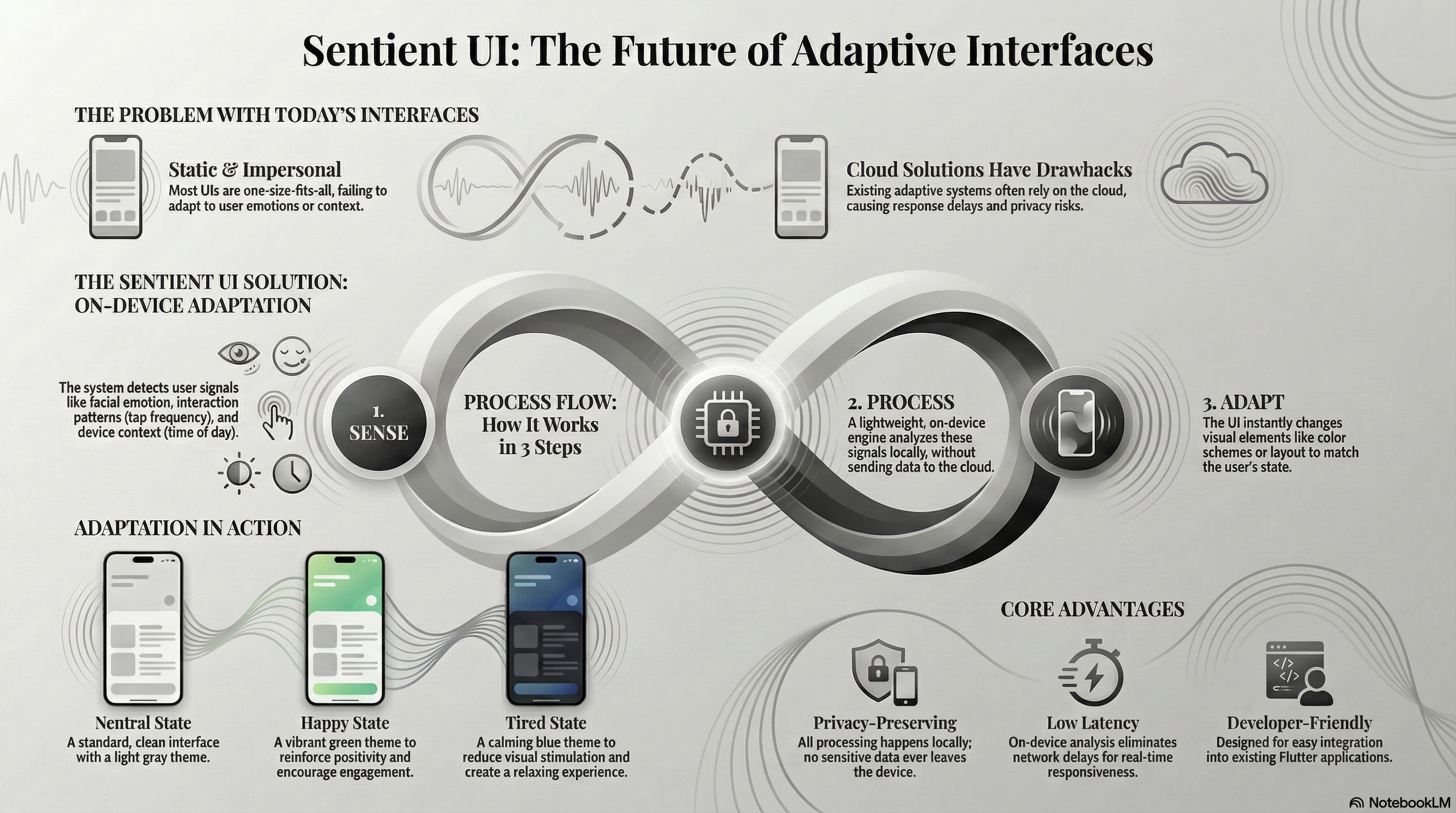
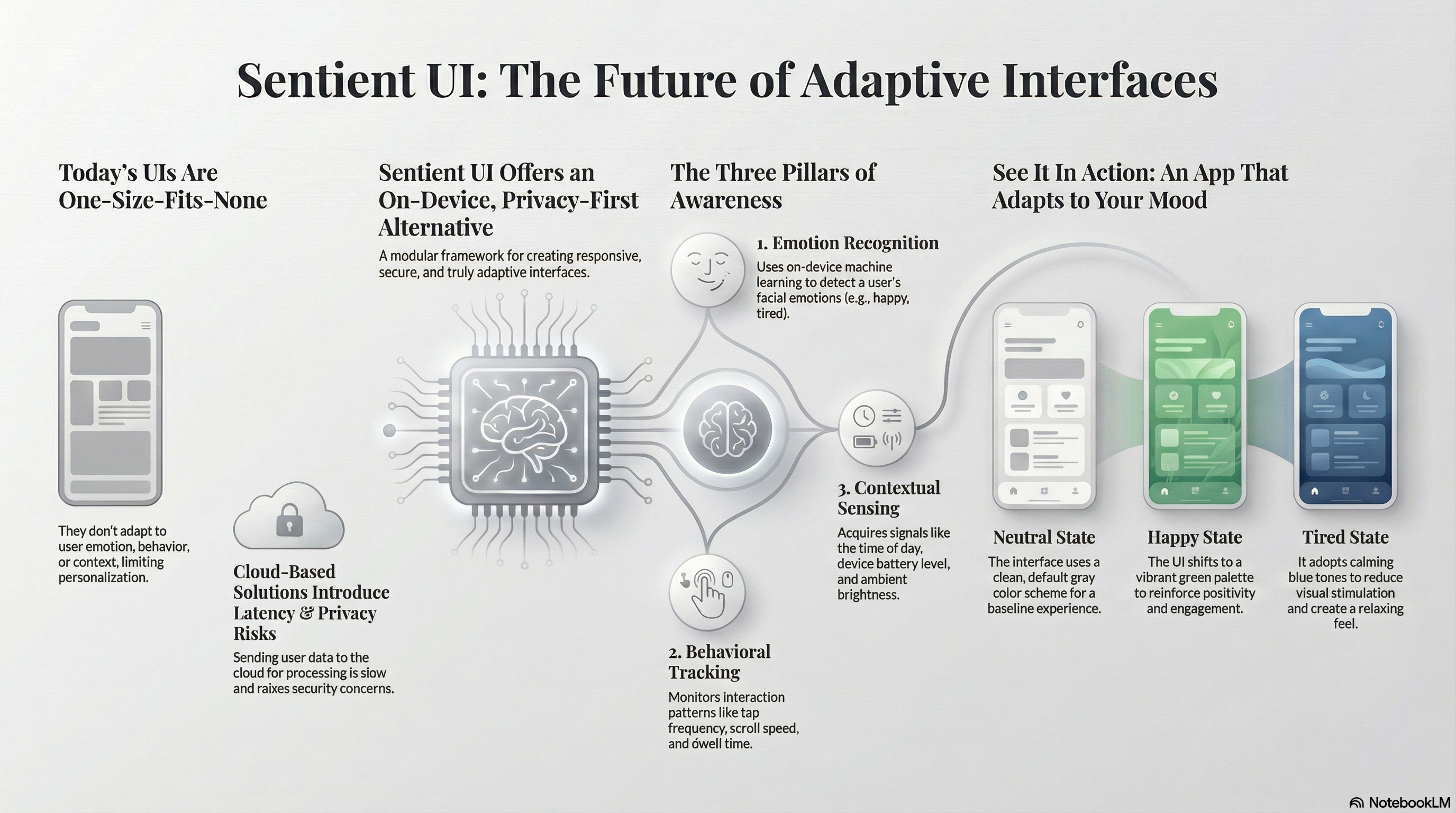
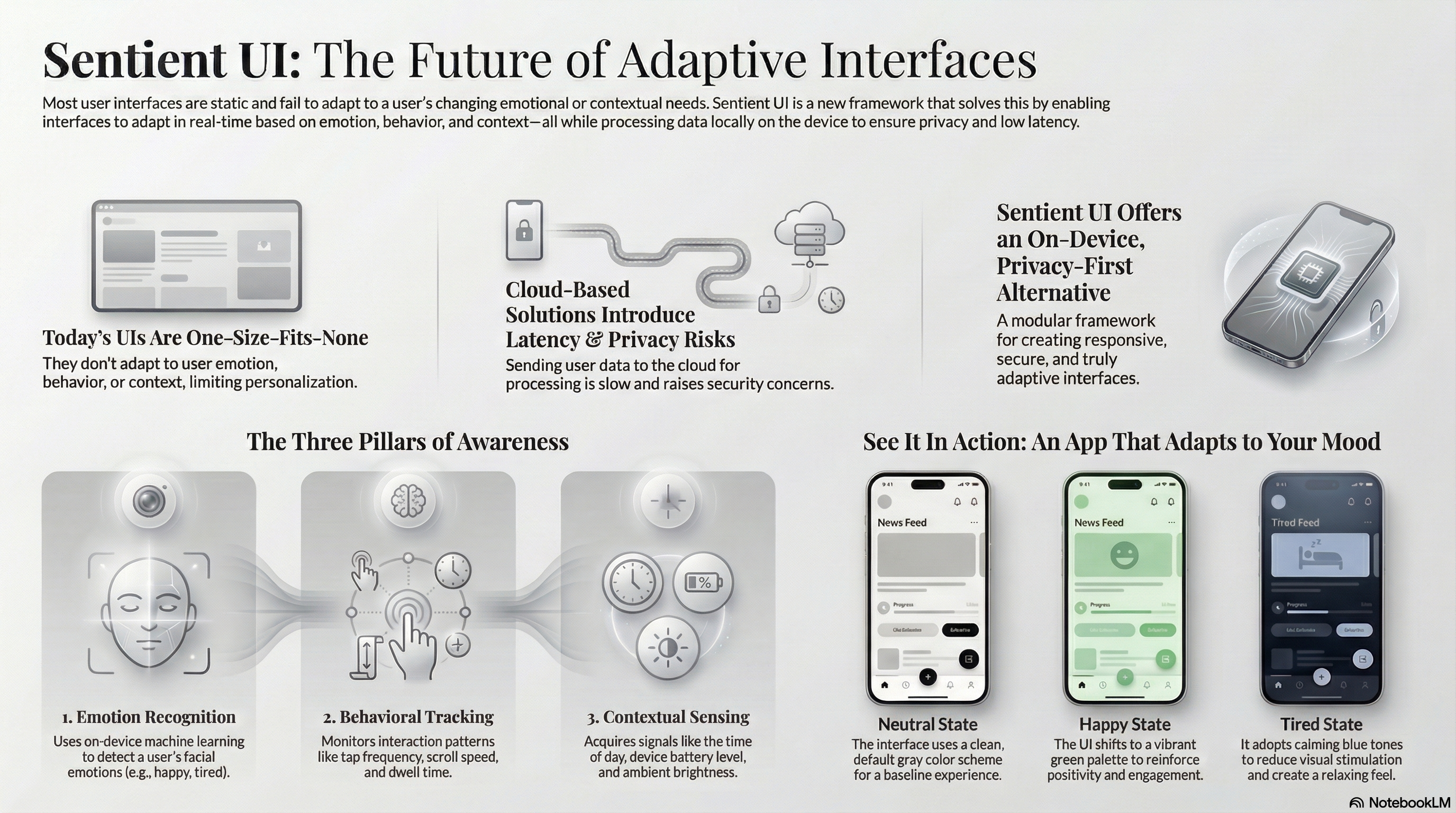
Loading Sentient UI Introduction...
Watch how Sentient UI adapts to user emotions in real-time
Duration: 5:55 | Created By NotebookLM
Sentient UI Framework
v1.0.0
An interface that perceives, learns, and adjusts—silently and intelligently. Adaptive design that responds to your emotional state and context in real-time.
Noise Reduction
Via Bayesian Sequential Updating
Frame Budget
Maintaining smooth 60fps transitions
Lines of Code
Average integration per component
A research-driven framework exploring how modern user interfaces can adapt to emotion, behavior, and context through modular, privacy-preserving, on-device design.
A Modular On-Device Framework for Adaptive User Interfaces
RESEARCH SUMMARY
Sentient UI investigates how adaptive user interfaces can be engineered using clean architectural separation and on-device processing. The framework integrates emotional state modeling, behavioral analysis, and contextual awareness to drive real-time visual adaptation while preserving privacy and developer control.
Architecture
A layered design separating signal detection, processing, adaptation logic, and UI integration for extensibility and maintainability.
Validation
A Flutter-based proof-of-concept demonstrating smooth, real-time visual adaptation under simulated emotional states.
View Research Paper
Architectural details & technical discussion
A Modular Framework for Dynamic User Interfaces
This paper presents Sentient UI, a Flutter-based framework for emotion-aware user interface adaptation that operates entirely on-device. The framework introduces a modular architecture that separates emotion recognition, behavioral tracking, contextual awareness, adaptation logic, and UI integration. A proof-of-concept demonstration illustrates real-time visual adaptation under simulated emotional states, validating architectural feasibility while preserving user privacy and avoiding reliance on external cloud services. The work emphasizes engineering design and system architecture rather than large-scale user evaluation.
Contemporary user interfaces remain largely static, providing limited responsiveness to variations in user emotion, interaction behavior, or situational context. While adaptive user interfaces have been explored extensively in academic research, their practical adoption is constrained by architectural complexity, privacy concerns, and integration overhead.
Sentient UI addresses these limitations by proposing a clean, modular architecture that enables emotion-aware adaptation directly within Flutter applications. By prioritizing on-device processing and explicit developer control, the framework aims to bridge the gap between adaptive UI research and real-world software engineering practice.
Sentient UI follows Clean Architecture principles and is structured into clearly defined layers, each with distinct responsibilities and interfaces. This separation of concerns promotes maintainability, extensibility, and independent evolution of system components.
Emotional input is modeled using lightweight on-device neural networks targeting Ekman's six basic emotions. Raw frame-level predictions are inherently noisy due to transient expressions and environmental variation. To address this instability, Sentient UI employs Bayesian sequential updating to aggregate predictions over time, producing temporally stable emotion confidence estimates.
Behavioral signals, including tap frequency and dwell time, as well as contextual signals such as time of day and device state, complement emotional input. These signals are normalized and fused using a confidence-weighted strategy to guide adaptation decisions while avoiding overreaction to transient events.
A Flutter-based proof-of-concept implementation demonstrates Sentient UI's ability to apply real-time visual adaptations under simulated emotional states. The demonstration focuses on validating architectural flow, adaptation triggering, and UI integration rather than production readiness.
Visual adaptations include color scheme transitions, contrast adjustments, and selective emphasis of interface elements, while maintaining consistent layout structure and functional behavior across emotional states.
The complete paper includes detailed architectural diagrams, mathematical formulation, and an extensive review of related work.
Last updated: December 2025
Sentient UI separates concerns through a modular structure, promoting extensibility while ensuring high cohesion.
Capturing multimodal signals through on-device sensors.
Transforming raw data into validated, normalized signals.
Decision engines that drive concrete interface transformations.
The SentientWidget wrapper system for fine-grained control.
Each layer is designed for maximum privacy—no data leaves the device. All processing and adaptation occur entirely locally, with no network connectivity required at any stage.
Modular Flutter framework for emotion-aware UI adaptation.
Stable release · Jan 11, 2026
A modular design that isolates domain intelligence from infrastructure responsibilities.
Report Issues & Contribute